Skip to content

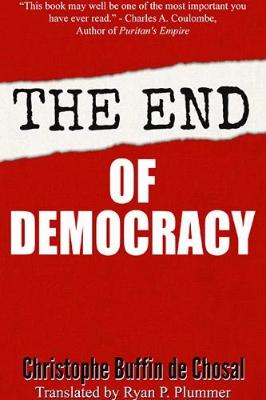
The End of Democracy

Original price $17.95 - Original price $17.95
Original price $17.95
$17.95
$17.95 - $17.95
Current price $17.95
Publisher: Tumblar House
Publication Date:
Format: Paperback
Pages: 172
Availability: In Stock
Estimated Delivery: 5–10 business days (U.S.)
Shipping: Calculated at checkout

Most people would agree that democracy throughout the world is in deep trouble. From the polarizing politics of the United States to the endless refugee crisis in Europe to the rise in radical Islam, there is a widespread feeling that our way of life—political, cultural, and social—is under siege. But what if democracy itself is to blame? What if the current threats are not distortions of but inherent to democracy? What if the solution to our present ills is not “fixing” the system, but junking it entirely? Christophe Buffin de Chosal asks these forbidden questions, and answers them unarguably with Gallic wit and glittering style. If you read only one book on politics this year, let this be it! Foreword by Charles A. Coulombe.

Read the First Chapter Now


Nothing is more dangerous to democracy than the people. That is why democracy will always claim to serve the people while only permitting a small number to rule in their stead. What democracy demands from the people is legitimacy. It does not care about their opinion.

The political parties put forward those of their members who show themselves to be the best manipulators. But among these, only those who are the most open to being manipulated themselves accede to power.

The ideal politician, on the other hand, is pliable, convincing, and a liar by instinct. He is not attached to any platform and has no ideological objective. The single thing to which he is truly committed is power. He wants its prestige and advantages, and seeks above all to be personally enriched by it. Any politician who presents this aspect is recognized as fit for power in a democracy.

Abstentionism lifts a corner of the veil. It is an important indicator. Far from being indifferent to election results, abstentionists consider it useless to vote, either because the candidate of their choice has no chance of winning or because, in their eyes, the country will be governed in the same way regardless of the winning candidate.

But when a party obtains an absolute majority, it can be tempted to put an end to the democratic system. Democracy is never protected from self-destruction. When the parties are too weak, it is the rule of the minority; when they are too powerful, they compromise the system. In both cases, democracy shows itself to be impossible.

The reality is that democracy was invented for the purpose of bringing an oligarchy into power and keeping it there.


Public sentiment ... has been conditioned so much against any other form of government and it has become so convinced that democracy, in spite of its weaknesses, is the system of humanity par excellence, that it cannot admit that this sure system could also be, like so many others, called into question.


It is striking to see how quickly a democratic population accepts as normal acts which it considered immoral, simply because they have become legal. Thus, wearing a safety belt inside a car has become a moral act because it is a legal obligation. Not insuring oneself when insurance is obligatory borders on immorality. Abortion and euthanasia, which revolted our grandparents, have become morally acceptable since being decriminalized. The salaries paid to political personnel, which constitutes an odious scandal in states claiming to be egalitarian, are generally accepted and at times even justified because they are legal.


Progress can only exist when we are convinced we can do better and that things can be perfected. How is it, then, we became convinced we could do no better than democracy?

Christophe Buffin de Chosal:

Christophe Buffin de Chosal is a Belgian historian and a writer. He is married and the father of six children. He lives in Belgium. He has worked for 25 years as a high school and university teacher in the fields of History, Economics and Politics. His main fields of expertise are Medieval and Modern History, Modern and Contemporary Politics. Since 1988, he has written articles for Correspondance européenne, a French-speaking press agency based in Rome.
  • 5 stars: 16 (84%)
  • 4 stars: 3 (16%)
  • 3 stars: 0 (0%)
  • 2 stars: 0 (0%)
  • 1 star: 0 (0%)
D
Diego Aguilar
Democracy before the Fall

Christophe Buffin de Chosal's book The End of Democracy is for most people an introduction to the forbidden side of politics, that is, the questioning and exposing the democratic principle (or lie as will be read). In only 160 pages, Christophe will reveal more about the nature of democracy than is talked about among many of the peoples to-day. From talking points about basic fundamental ideology, to history, and even more niche (or taboo?) topics such as the destruction of the family being a result and not symptomatic, the examples provided are taken from the real world and are discussed thoroughly. Each chapter is filled with potent quotes that definitely capture the attention of readers (and passersby), well thought out arguments, and insights that, if one is not familiar with, are quite shocking. It can be somewhat dense at times and definitely will need re-reading, but after reading this work, it was well worth it. Definitely a gift for those who think they "know/love" democracy. 5 stars and would highly recommend for those more curious readers.

R
Ron Benkendorf
All Christians can concur

Man’s true political wisdom is only learned from experience. A good government cannot be the invention of sagacity in any man, but must be the growth of events under the hand of Divine Providence. The spirit of innovation is contagious; and men who have departed in important respects from the established order, grow impatient for further experiment. -R.L. Dabney

H
Harold Day
Review of The End Of Democracy

This is too long and rambles but you are welcome to as much or little of it as you deem fit. Discovered Off The Menu on youtube beginning of this year. Now on Monday look forward to spending an hour or so with you and Charles. Keep up the good work and God bless you both.

"
As a history minor in university in the late 60s, developed a lifelong interest in History, mostly Military History. A few years back the Peloponnesian War caught my attention, once again read Thucydides cover to cover and many later historians’ work.

This time around one of the prior unnoticed sub-texts was the volatility of the Athenian democracy. Granted it was a direct democracy therefore lacking the supposed buffers of a representative republic but as the last few decades have proven in America, the designed in checks and balances are not working.

On multiple occasions the Athenian demos would decide one thing one day, sleep on it overnight and the very next day vote almost the complete opposite.

One author in particular opined that the Spartans were indeed fighting for “the freedom of the Greeks”, while the Athenian Delian League was in fact an Athenian Empire. The Athenian democracy was more oppressive and repressive of their allies than the supposedly retrograde Spartans.

A number of later writers who site ancient sources advise that in the past democracy was not a favored form of governance, being at best emotional, unpredictable and easily swayed – not attributes sought in an ally. At worst, it is simply mob rule; a thin reed to hang a political system on.

Christophe Buffin de Chosal’s book is more than a replay of ancient critiques of democracy, it is an in-depth analysis of why it is a flawed system that is bound to fail by its very nature.

He elucidates how is in not Marxism, secularism, feminism, modernism et al that causes the eventual failure of democracies, much like Original Sin in humans, the seeds of its destruction are sown at its inception.

One example is that those who rise to positions of power from the local school board to the leaders of nation states are invariably the least desirable folk to have making decisions. To a greater or lesser degree, they are self-promoting egotists who once in power are only concerned with staying in power, even going so far as to make feints of providing succor to those who elected them.

Chosal offers myriad other examples and evidences of the innate long-term unviability of democracy. While he offers no solid alternatives, he is still worth the read if no other reason than to reaffirm one’s prejudices that we are living in a failed state.

A
Adrian Garcia
Quick and Easy

In this book you have a quick and easy guide to unmask democracy as the farce that it is. Ever wonder why all our politicians are such scumbags? Ever wonder why our national debt is ever increasing? This book has the answer. Perhaps of most interest was the chapter in which the swine flu pandemic was touched upon. Large amounts of money was spent on vaccines and when they were finally made available to the public, the "pandemic" was over. Truly makes one wonder.

J
Julie Thomas
Good Read

The book is a very accurate depiction of the current democratic system, who is really in control of the decisions being made, and the negative impact it is having on society.

P
Pierre
Excellent unmasking of liberal "democracy"

This book is FILLED to the brim with arguments that thoroughly debunk the liberal premises that animate our current world.
Absolutely loved it.

A
Aaron Russell
A necessary and disturbing read.

There are many aspects of culture we accept without question. Democracy as "good" being one of them. This book offers a rare critique we can all benefit from.
I imagine the author lies awake at night, disturbed by how prophetic his book was. I'm reminded of my feelings reading 1984; and that was a decade ago.
Democracy, like Communism is a Utopian ideal with no basis in natural law. Thus, in every case it devolves into something more natural and less democratic.

E
Eric Hall
So true it almost doesn't need to be said

A few years ago this book would have been considered radical for its suggestion that "democracy" and "representative government" are mirages contrived by a consolidated oligarchy for the unsuspecting masses, but having acquired this book in the year 2020, it seems that everyday experience is confirming the thesis, in my opinion at least. The End of Democracy is hard to unread!

There are two good reasons for buying this book. First, if you want to challenge your good faith in the democratic ideal with clear arguments and strong facts, and second, if you want a cogent explanation for the things you see on TV and the irrational spin of modern political discourse. In either case, you won't be disappointed!

B
Britteny Papic
Necessary for Those to Focused on Modern Politics

This book is a necessary read for those who struggle with getting caught up in modern politics and does well reminding us about the importance of Catholicism in all political decisions.

C
Colin Singleton
Good so far!

Haven't quite finished, but so far this book is an inoculation against democracy and all its sinister trappings that I didn't know I needed.

The author is just a touch too sympathetic to the Austrian School of Economics for my taste, but that's a minor detail.

M
Michael
Excellent Read

This book is an incredibly coherent and engaging read throughout. Ryan Plummer did an excellent job translating, and Mr. Chosal, of course, is a very good author. I highly recommend this book!!!

D
Dylan Smith
The End of Democracy

Fantastic book. It is short but has more substance than most books I've read.

E
Editors Christus Rex
Demonocracy: The Great Human Scourge!

Introduction

One cannot speak too highly of Christophe Buffin de Chosal’s The End of Democracy. In a fast paced, readable, yet scholarly fashion, Professor Buffin de Chosal* demolishes the ideological justification in which modern democracy rests while he describes the disastrous effects that democratic rule has had on Western societies. He explodes the myth of Democracy as a protector of individual liberty, a prerequisite for economic progress, and a promoter of the higher arts. Once Democracy is seen in this light, a far more accurate interpretation of modern history can be undertaken. The book is a very suitable companion to Hans-Hermann Hoppe’s iconoclastic take down of democracy in Democracy: The God That Failed, released at the beginning of this century. Buffin de Chosal has spoken of a follow up which will be eagerly awaited for.

The rest can be found here: https://christusrex.site/2019/07/19/demonocracy-the-great-human-scourge/

eds

C
Casey Hyde
The End of Democracy

Good subject matter. Bought it as gift. Want to buy one for myself. I am excited to read it.

C
Charby Xu
A Great and Concise Read

Christopher Buffin de Chosal manages to erase all of my misconceptions about democratic governments that I've held in certainty since my schoolboy days in 161 pages. He manages to expose democracy as not a system of the state giving the masses power, but rather one of the ruling class obtaining legitimacy from the masses.
Overall, this is a very good read. I only did minimal reading every day, and I managed to finish the book in two weeks.
Highly recommended to fellow conservatives to realize that democracy was never meant to function in favor of their interests.

V
Vincent Frankini
Ultimate red-pill book loaded with truth bombs.

This book will blow your hair back. I read this with a pen and marked every line that I felt was a standalone quote worthy of being posted on the internet. In total I ended up with over 40 quotes. There are so many truth bombs in this book, it's truly unbelievable. Whenever I encounter someone in a political argument, I suggest that they read this book, address its arguments, and then get back to me!

D
Diego Torres
Succinct

Very little reading time wasted, if nothing at all, bravo!

C
Christopher Fitzgerald
Two End are Better than One

Everyone recognizes that modern democracy and representive republics have become wholly corrupted, representing only the interests of moneyed powers and radical ideological groups, but what is seldom recognized is that this end was initially intended by design. The End of Democracy exposes that end, and yet points also to its looming and inescapable final end.

M
Matthew Olson
Brilliant Busting of Myth

Christophe Buffin de Chosal brilliantly busts democratic myths. Do the liberals really care about us? Are all of their decisions really motivated by "the will of the people"? Well...

"The parliamentary regimes which issued from the French Revolution imitated the British system: a king not in charge, ministers responsible to the Houses, and, above all, no universal suffrage. The bourgeois regimes' distrust of universal suffrage is easily understood. At the time, universal suffrage would have reinforced the conservatives, for the population would have spontaneously voted for its natural elite: manorial lords, notaries, and parish priests. ... Towards the end of the nineteenth century, the two states practicing universal suffrage were also the two most powerful and most conservative monarchies: Germany and Austria-Hungary." (p. 18-19)

On p. 45, the author makes a point increasingly common among monarchists, that of "time preference".

In his fifth chapter, the author tries to uncover what good the European Union does that outweighs its ills and cannot be done by nations, finding none. In his sixth chapter, he argues that democracy naturally drifts left. In his seventh chapter, he argues that democratic government brings the incompetent, not the competent, to positions of power. In the final chapter, he makes an interesting comment about popes John Paul II and Benedict XVI: he says that they "rightly pointed out that democracy should not be an ideology, but rather a simple system of governance and representation subject to moral imperatives; they made the mistake of believing, however, that democracy was such a system and that it could submit itself to 'non-negotiable' values" (p. 152-153). He also raises the startling possibility that Muslim society "will even seduce numerous Westerners at a time when parliamentary democracy will reveal its inability to serve the good of peoples" (p. 157).

Editorial Reviews

"This book may well be one of the most important you have ever read." - Charles Coulombe, author of Puritan's Empire.

"One cannot speak too highly of Christophe Buffin de Chosal’s The End of Democracy.  In a fast paced, readable, yet scholarly fashion, Professor Buffin de Chosal demolishes the ideological justification in which modern democracy rests while he describes the disastrous effects that democratic rule has had on Western societies.  He explodes the myth of Democracy as a protector of individual liberty, a prerequisite for economic progress, and a promoter of the higher arts. "  -- AntoniusAquinas.com